
3rd Jun 2026
Alternative to Psychiatric Hospital Admission
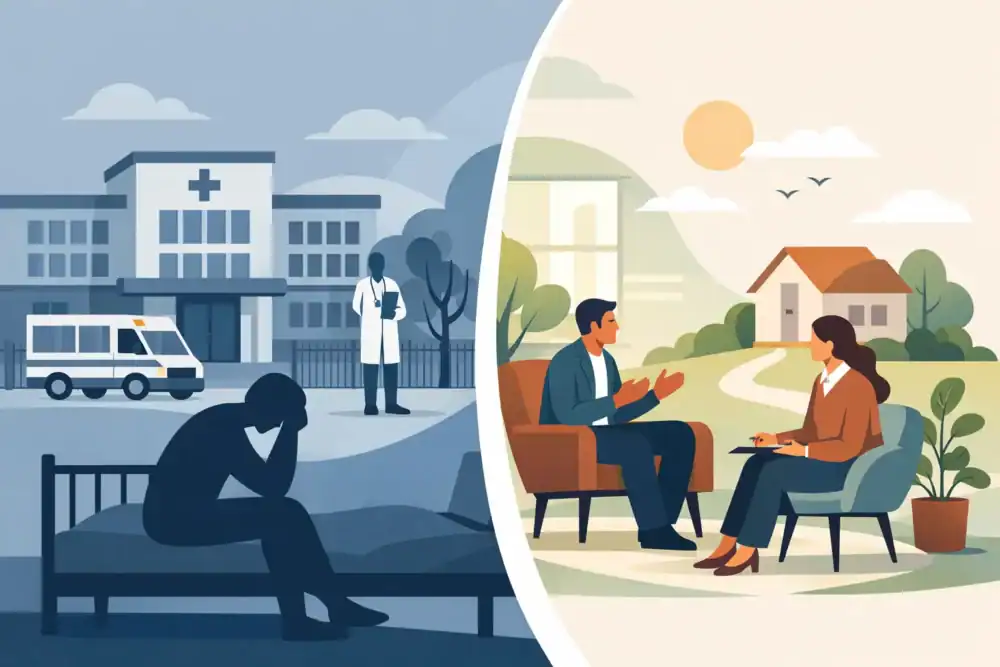
When a young person is in crisis, the first question is often whether they need hospital care. Yet for many 16 to 30-year-olds with complex mental health needs, an alternative to psychiatric hospital admission may be not only appropriate, but more effective in supporting safety, stabilisation and longer-term recovery.
That matters particularly where there is a pattern of repeated admissions, placement breakdowns, high-risk behaviour, emerging personality difficulties, eating disorders, trauma-related presentations or co-occurring autism and mental ill health. In these situations, hospital can be necessary at times, but it is not always the setting most likely to reduce risk over the longer term. A more specialist, less restrictive residential model can sometimes provide the structure, therapeutic input and continuity that young people need to move forward.
What makes hospital admission the wrong fit for some young people?
Psychiatric inpatient care has an essential role in acute mental health treatment. Where there is immediate and severe risk, detention under the Mental Health Act, or a need for intensive medical monitoring, hospital may be the right and safest option. The difficulty is that not every high-acuity presentation is best managed on a ward.
Some young people deteriorate in inpatient environments. They may struggle with the intensity, the loss of autonomy, the disruption to education or routine, or the impact of being cared for alongside others who are also highly distressed. For autistic young people in particular, ward environments can be overwhelming and dysregulating. Others may become caught in a cycle of admission, discharge, relapse and readmission, without enough time or relational continuity to address the underlying drivers of risk.
For referrers and commissioners, this is often the point at which the question changes. It becomes less about whether the young person needs support, and more about what type of support is most likely to deliver stability, engagement and a realistic pathway towards independence.
An alternative to psychiatric hospital admission can fill a critical gap
Between acute inpatient care and unsupported community living, there is a service gap that many professionals know well. Young people who are too high risk for generic placements may also be too clinically complex for standard supported accommodation. At the same time, they may not require the restriction of hospital, or may actively need a more relational and developmentally informed setting.
This is where specialist residential mental health care can act as an alternative to psychiatric hospital admission. The model works best when it combines accommodation with 24/7 staffing, risk management, therapeutic support, medication oversight and access to a multidisciplinary team. Rather than responding only to crisis points, it creates a stable environment in which risk can be understood, patterns can be reduced and progress can be sustained. It is also important to recognise that often it can be difficult to access specialist residential care quickly, and in a crisis situation time can be of the essence. In such situations, a rapid intake and assessment to a specialist mental health support residential setting can make all the difference in offering a realistic alternative to a hospital admission.
The value of this approach is not simply that it avoids admission. It is that it offers a clinically integrated setting where young people can practise daily living, build trust, engage in therapy and move gradually towards greater independence, without the abrupt step from ward to community that so often leads to further breakdown.
What a strong residential alternative should include
Not every non-hospital setting is suitable for a young person with complex mental health needs. The quality of the alternative matters. For a placement to be credible, it should be able to demonstrate clinical oversight, a clear risk framework and a proven ability to work with high-acuity presentations.
In practice, that means more than providing a bed and basic support. Effective residential services should offer round-the-clock staffing, trauma-informed care, positive behaviour support where needed, medication management and regular input from professionals such as psychologists, psychiatrists, nurses and dieticians. For those with eating disorders, self-harm, suicidal ideation or severe emotional dysregulation, the support plan must be specific, responsive and embedded into everyday care.
The environment matters as well. A least restrictive approach is often central to progress, but it must sit alongside strong safeguarding and well-defined clinical boundaries. Young people need consistency, not over-control. They need a service that can manage risk confidently while still promoting autonomy, dignity and development.
Who may benefit from an alternative to psychiatric hospital admission?
There is no single profile, and decisions should always be based on assessment. However, residential alternatives are often particularly relevant for young people and young adults who have experienced repeated admissions, failed foster or residential placements, delayed discharges, or escalating risk in the community without a workable support framework.
This may include those living with severe anxiety, depression, complex trauma, emerging personality disorder, psychosis in recovery, eating disorders, self-harm, suicidality or significant emotional dysregulation. It may also include autistic young people whose needs are poorly met in generic mental health settings, and who require an autism-informed environment with predictability, sensory awareness and relational consistency.
The key question is not whether the young person presents with risk. It is whether that risk can be managed safely in a structured residential service with clinical input, and whether the environment is likely to support engagement better than an inpatient ward. For many referrers, that assessment sits at the centre of effective pathway planning.
Why outcomes often depend on continuity, not just containment
One of the common limitations of inpatient care is that it is designed primarily for acute containment and stabilisation. That can be life-saving, but it does not always create the conditions needed for sustained recovery. Young people with long-standing relational trauma, attachment disruption or repeated service breakdowns often need more than short-term crisis management.
They need consistency across days, weeks and months. They need staff who know their triggers, their communication style and the early signs that risk is increasing. They need support with practical routines such as sleep, nutrition, appointments, education, budgeting and community access, because these are often the foundations of stability.
A specialist residential placement can provide that continuity. It allows therapeutic work and risk management to happen in the real context of daily life, rather than in isolation from it. That makes it easier to measure progress in meaningful terms: fewer incidents, reduced admissions, improved engagement, stronger emotional regulation and a more realistic transition towards independent living.
What referrers should look for in a provider
For local authorities, NHS teams and clinicians, choosing an alternative placement requires confidence that the service can hold complexity safely. This means looking closely at staffing, governance, clinical integration and evidence of outcomes.
A strong provider should be able to explain how referrals are assessed, how risk is reviewed, what multidisciplinary input is available and how the service manages crisis without defaulting immediately to hospital. It should also be clear about the limits of the placement. A responsible provider will not present residential care as a substitute for every form of inpatient treatment, because there are situations where hospital remains necessary.
It is equally important to ask about progression. The most effective services do not create dependency. They build towards greater independence through planned transitions, step-down support and close partnership with the wider professional network. That collaborative approach is often what prevents a stable placement from becoming another dead end.
Care in Mind is one example of a specialist provider working in this space, with a clinically informed residential model designed for young people whose needs sit between hospital and unsupported community living.
A better pathway is often a less restrictive one
The phrase least restrictive can sometimes be misunderstood as less intensive. In reality, the opposite is often true. A well-designed residential service can be highly structured, clinically informed and closely monitored, while still giving the young person more agency, more normality and more opportunity to develop everyday coping skills.
That balance is often what makes it effective. When young people feel safer, better understood and more involved in their care, engagement tends to improve. When support is consistent and multidisciplinary, crises can be identified earlier and managed more proactively. Over time, this can reduce the need for repeated admissions and create a more stable route towards recovery.
For professionals planning care pathways, the goal is rarely to avoid hospital at all costs. It is to match the young person with the setting most likely to keep them safe and help them make progress. Sometimes that will be inpatient treatment. Sometimes the better alternative to psychiatric hospital admission is specialist residential care that offers clinical support, relational stability and a clear path towards independence.
The most helpful question is not simply where a young person can be placed next, but where they have the best chance to recover, remain safe and build a life beyond crisis.